Ice House Museum

Home | Calendar of Events | Cedar Falls History | Special Activities | Museums
Events and Exhibit Articles | Membership | Fall 2008 News Letter (pdf) | Other Sites
Educational Opportunities | Research Library | Donating To The Cedar Falls Historical Society
Board of Directors | Staff | Volunteer Positions

CFHistory.org

Ice House Museum

Franklin St. at West 1st Street
Cedar Falls, IA 50613
Open: May 1st through September 30th
Wednesday, Saturday, Sunday 
hours: 2p.m. - 4:30p.m.

Tours & Research - Arranged by calling (319) 266-5149
or e-mail at: cfhistory@cfu.net


The Ice House Museum features an outstanding display of the items used in cutting, harvesting, storing, selling and the use of natural ice.  The 600 square foot display area for tools and implements used to cut natural ice was completed in 1991.  A large mural showing the Cedar River in winter forms the background for a "frozen" river where tools of the trade are displayed.

Blocks of "ice" are stacked as they would have been in the ice house with the tools used by the men who delivered ice to homes and businesses throughout the area.

Life-sized photos of two early ice men along with several different types of ice-boxes, a large two-horse ice wagon, original photos and an information panel that explains the process of cutting ice, help visitors to understand this unusual industry that existed in almost every town in America in the last half of the 1800's and early 1900's.  A scale model of the ice house in the early 1920's is also featured.

The kitchen highlights an ice box with an "outside" door for ice deliveries, a coal range, pie safe, and cistern pump.  An outhouse and other "conveniences" of that time show what life was in the early days of the 20th century.

A horse-drawn school bus, buggies and sleighs, a 1909 Reo and 1925 Ford auto are displayed along with early horse-drawn farm implements and historic items from early Cedar Falls businesses.  Our newest addition to the ice house collection is a 1935 model B John Deere tractor.

Completed in 2000, an exhibit of early Cedar Falls businesses now surround the perimeter of the ice house.  Visitors can stroll down Main Street and visit Dr. Theirman's office, the Diamond Bros. General Store, or take a seat in the Empress Theatre.

Two slide presentations have been produced by the Cedar Falls Historical Society Ice House Museum.  They are available by contacting the office at (319) 266-5149.


TOP


History of the Cedar Falls Ice House..

The Cedar Falls Ice House was built in November, 1921, by Hugh Smith, owner of the Cedar Falls Ice and Fuel Company.  The first ice house had been built in this location in 1858 near the cabin site of Black Hawk County's first permanent settler, William Sturgis.  

The old wooden ice house was destroyed by fire on the night of October 22, 1921.  On that night, Smith and his wife were attending a performance at the Cotton Theatre, (now the Regent Theatre).  His son located Smith in an aisle seat and whispered, "Papa! The ice house is burning down!"  Smith hurried to his place of business and watched the ice 
house go up in flames in less than an hour.

On October 24, 1921, The Cedar Falls Record reported: "An expert building engineer from Chicago is en route today on a telegraphic call  from Manager Smith to assist him in drawing up plans for a reinforced structure to replace the old frame building."  The community rallied to Smith's aid.  On the Thursday following the fire, 200 volunteers cleared the rubble, and the footings for the new ice house were poured less than a week after the old house had burned down. A few days later the walls of the new building were started.

The new building was 100 feet in diameter with tile walls 30 feet high.  The walls were made of hollow clay tile reinforced  with steel  ties between the layers of tile.  The ice house had a capacity for 6,000 to 8,000 tons of ice.

Early on the morning of January 10, 1922, the first ice harvest for the new ice house on the Cedar River was begun.  At the close of the 1922 harvest, carpenters assembled and raised the trussed double-pitched roof by using the top layer of blocks as a scaffold.

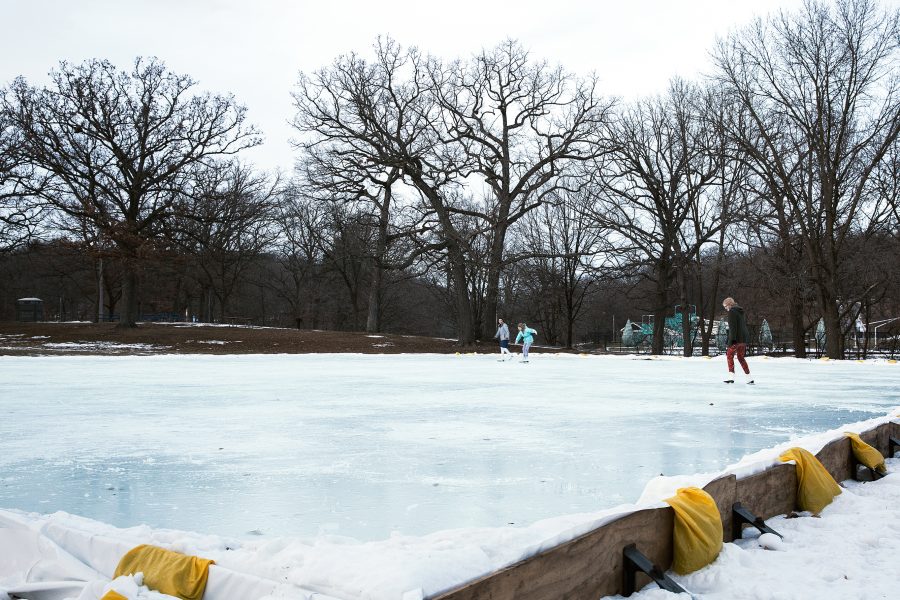
The building was used as an ice house from 1922 until 1934 when Hugh Smith lost his business and the property was taken over by the Cedar Falls Trust and Saving Bank.  For a time the building was used as a livestock sales pavilion and later flooded for ice skating.

In 1938 members of the Cedar Falls Boat Club persuaded the city to purchase the building.  Subsequently, the Club leased the structure from the city for use as a boat storage building for the sum of $1.00 per year.  The Boat Club occupied the ice house until 1976 when the roof was deemed unsafe and the building condemned.

In November of 1976, the bicentennial Year, the members of the Board of Directors of the Cedar Falls Historical Society agreed unanimously that every effort should be made to preserve the old ice house for use as a museum.  

With the assistance of The Cedar Falls Daily Record, the Society launched a campaign which met with wide-based community support.  The City allocated block grant money, and a successful fund drive saved this unique building.

In the summer of 1978 contractors put in a new cement floor and electrical system and made major repairs to the roof.  The unusual umbrella styled roof is supported by one center pole and the outside walls of the structure.

The Ice House Museum opened to the public on June 24, 1979, and is operated by the Ice House Management Council which is responsible to the Board of Directors of the Cedar Falls Historical Society.


TOP


Historic Cedar Falls Marker by the Ice House Museum

Erected by the Iowa State Historical Department, Division of the State Historical Society and by the Cedar Falls Historical Society.  Donated by Kiwanis, Lions, and Rotary Clubs of Cedar Falls 1980.  Written by Dr. Leland Sage.

"On Lands acquired by the USA from Sac and Fox (Mesquakie) Indians in 1842, William Sturgis and Erasmus D. Adams settled near this spot along the Cedar River in 1845.  Sturgis began construction of a dam and mill and the site became known as Sturgis Falls, the first permanent settlement in Black Hawk County.  Early residents were Andrew Mullarky; John and Dempsey Overman, who completed the mill; A.J. Taylor and wife the "first school marm"; Peter Melendy, Zimri Streeter, Samuel H. Rownd.  Moses Sawyer, S.A. Bishop, C.A. Wise, and others.  The hamlet soon counted seven mills along its mill race.  In 1849 it was incorporated as a village and the site name changed to Cedar Falls."

Key developments in the city's history were: 

bullet 1855: Cedar Falls loses the battle for the county court house in Waterloo.
bullet 1861: Illinois Central railroad builds as far as Cedar Falls.
bullet 1861 - 1865: Cedar Falls stands strongly pro-union during the Civil War. 
bullet 1866: Illinois Central Railroad resumes westward construction.
bullet 1860's: Danish migration to Cedar Falls and vicinity begins.
bullet 1876: Iowa State Normal School founded; later known as Iowa State Teachers College, 
State College of Iowa, University of Northern Iowa.
bullet 1882 - 1950: Danish-language newspaper, Dannevirke, enjoyed influential career.
bullet 1904: Invention of  rotary pump by Jens Nielsen, local quarry owner, leads to formation of Viking Pump.
bullet 1918: John Deere Company comes to Waterloo, with professional, social and economic effects on Cedar Falls. Meanwhile, the Clay Equipment (farm machinery) and many similar companies contributed greatly to the growth of Cedar Falls, "The Lawn City", a cultural, educational, recreational, and religious capital of Northeast Iowa.
bullet The Interdenominational Bible Conference has held annual encampments since 1922.
bullet The Cedar River, George Wyth Park, and Black Hawk Park are widely enjoyed sources of pleasure.
bullet Every census except 1910 has shown an increase in population.
The figure in 1970 was 29,597; in 1980, about 36,000.
bullet Prominent residents have been: Bess Streeter Aldrich, novelist; Homer H. Seerley, college president; 
John Livingston, aviator; Ruth Suckow, novelist.


TOP

Visit the 
Wyth House and Viking Pump Museum
the Victorian Home and Carriage House Museum
"R" Little Red School House Museum
Behrens - Rapp Station Museum and Visitors Center,
and Lenoir Model Train Museum

Cedar Falls Historical Society ã 2002
For Problems or questions regarding this web site contact cfhistory@cfu.net.
Last updated: 05/03/2006